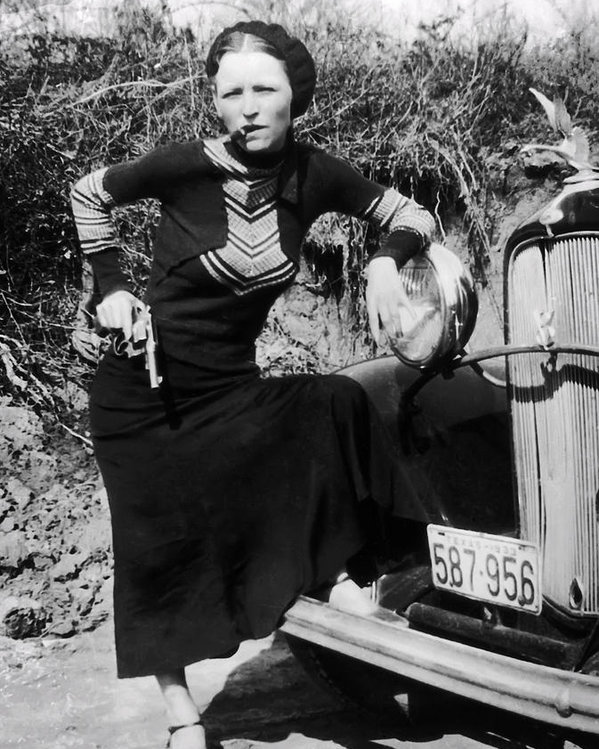


By the spring of 1934, Bonnie Parker and Clyde Barrow had become two of the most wanted people in America. Their two-year crime spree — a string of bank robberies, gas station holdups, and violent encounters with law enforcement spanning four states — had left thirteen people dead, including nine police officers. Their exploits had made them folk heroes in some corners, objects of obsession in the press, and priorities for a federal bureau still finding its footing under J. Edgar Hoover.
Bonnie Elizabeth Parker and Clyde Chestnut Barrow were an unlikely pair. Parker, born in 1910 in Rowena, Texas, had married at sixteen but soon found herself drawn to Barrow, who had been convicted of armed robbery and served time in prison before being paroled in early 1932. Together with a rotating cast of associates — the Barrow Gang — they robbed banks and small businesses, stole cars, and left a trail of dead lawmen across Texas, Oklahoma, Arkansas, and Missouri. Parker, who was with Barrow through most of it, became the stuff of legend: photographs of her posing with a cigar and a rifle, found in an abandoned Missouri hideout in April 1933, cemented her image in the popular press as the gun-toting "gun moll."
By May 1934, Barrow had sixteen outstanding warrants for robbery, auto theft, assault, and murder across four states. The Division of Investigation — the federal bureau that would not be renamed the FBI until 1935 — had made the pair national priorities. Frank Hamer, a former Texas Ranger brought in earlier that year specifically to track Barrow, assembled a six-man posse in Louisiana, combining his own expertise with officers from the Texas Department of Corrections and the Dallas Sheriff's Office. They had received a tip that Barrow and Parker were in the area, and Henry Methvin's father, Ivy, had agreed to cooperate with authorities.
On the morning of May 23, 1934, the six lawmen were concealed in the bushes along a rural road near Sailes, in Bienville Parish, Louisiana. Ivy Methvin — Henry's father — had parked his truck by the roadside appearing to have a flat tire, set as a lure to slow any passing car. Around 9:15 a.m., Barrow and Parker appeared in their 1934 Ford V-8, moving slowly down the road. The posse opened fire. The barrage was overwhelming: more than 112 bullet holes were later counted in the vehicle, with approximately thirty rounds striking the couple. Both Parker and Barrow were killed instantly in the initial volley. It was approximately 9:20 a.m.
The Ford V-8 that carried them into the ambush had been a symbol of Barrow's obsession — he had written to Henry Ford in April 1934 praising the car's performance. Inside the vehicle, police found more than a dozen firearms, including automatic rifles and sawed-off shotguns, along with several thousand rounds of ammunition. The arsenal made clear that Barrow had been preparing for a fight, not a retreat.
Within hours of the ambush, word spread across the country. The bodies were taken to Conger Furniture Store and Funeral Parlor in Arcadia, Louisiana, where thousands of people descended, creating what one account described as a "circus-like atmosphere." Bonnie Parker's mother had wanted to bring her daughter home to Dallas, but mobs surrounding both the Parker house and the funeral home made that impossible. Barrow's family was permitted a private funeral at sunset on May 25. Parker was buried in Dallas; Barrow was buried alongside his brother Buck in a shared grave outside the city, inscribed with the words "gone but not forgotten."
The bullet-riddled Ford did not disappear with its owners. It became a traveling attraction, displayed at fairs and amusement parks for three decades. It eventually ended up at Primm Valley Resort near Las Vegas, Nevada, where it remains on display today, a relic of the Depression era's most romanticized criminals.
For law enforcement, the ambush was a triumph. It ended a two-year pursuit that had embarrassed federal and state authorities alike. Within months of Barrow and Parker's deaths, Congress passed a package of anti-gangster statutes that strengthened federal reach over crimes exploiting state-by-state jurisdictional gaps — a legislative effort already underway before their deaths, but part of a broader Depression-era crackdown on organized crime. By summer 1935, twenty family members and associates had been arrested and tried for aiding the fugitives.
Ninety-two years later, the ambush at Sailes remains one of the most dramatized criminal deaths in American history. Scholars and historians have continued to examine the reality beneath the legend: thirteen dead, nine of them law enforcement officers, and a country still reckoning with what the press coverage and public reaction revealed about Depression-era America.
