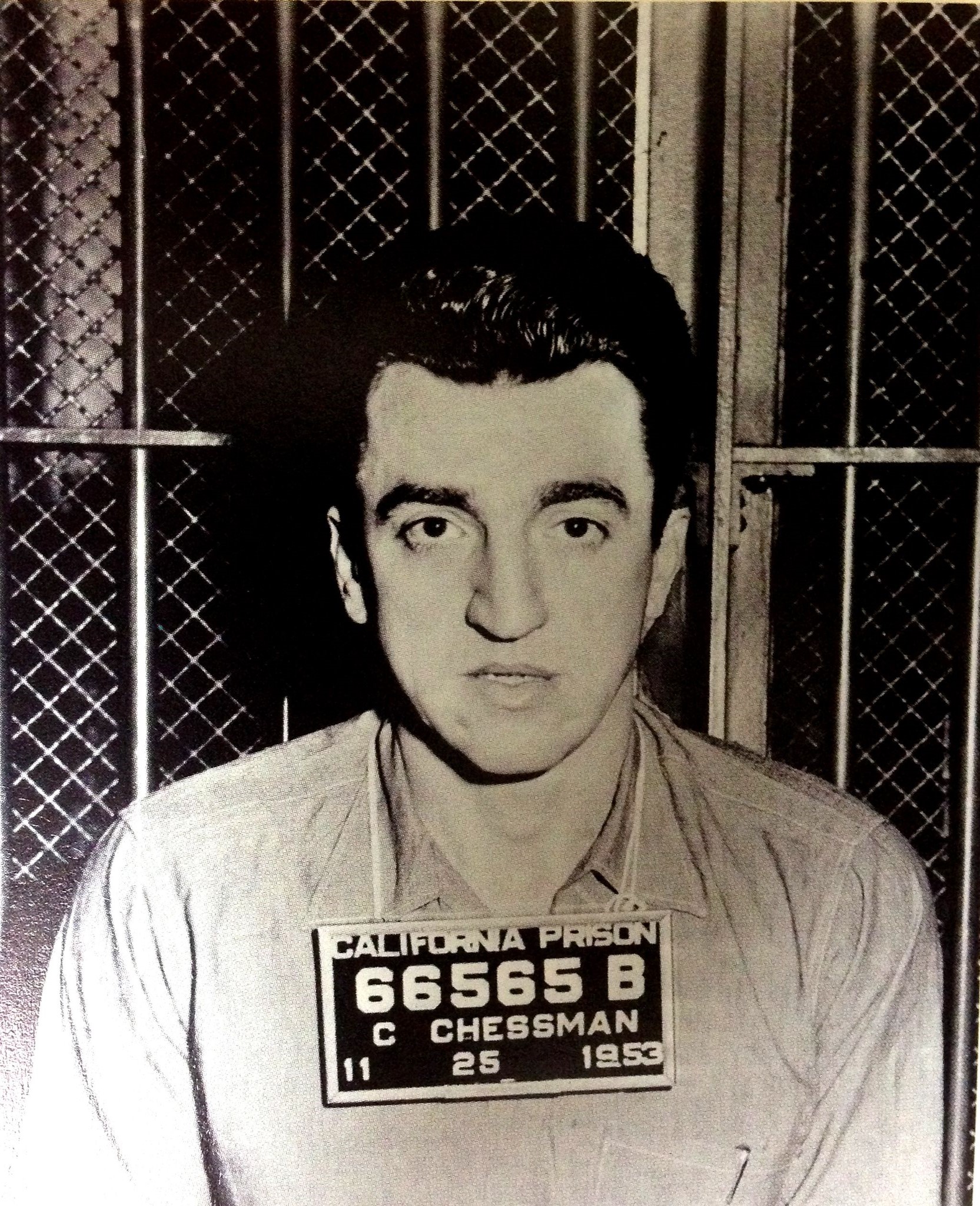
Caryl Chessman's story is one of the most extraordinary legal odysseys in American criminal justice history — a case that began with a dramatic arrest in Los Angeles in January 1948 and ended, twelve years later, with a controversial execution that ignited a national debate about capital punishment that has never fully subsided. Born in 1921 in Michigan, Chessman came to California as a young man and fell into trouble with the law. In early 1948, he was arrested as the suspected "Red Light Bandit" — a figure that Los Angeles investigators believed had been posing as a police officer, using a red spotlight to halt automobiles in secluded areas and robbing and assaulting the occupants. Chessman always insisted he was not the man responsible, and that insistence never wavered throughout the nearly twelve years he spent behind bars.
The trial that followed was swift and, in some respects, deeply flawed. Convicted of multiple counts of robbery, kidnapping, and sexual assault, Chessman received two death sentences under a California law — the so-called Lindbergh-era rule — that allowed capital punishment for kidnapping when the victim was physically harmed, even without a murder conviction. The court's official transcript was incomplete because the court reporter died before the full record could be produced, a fact that would haunt the case in subsequent years. Throughout his time on death row, Chessman was permitted remarkable privileges: he was allowed to keep writing materials, and from his cell he produced four books, including the bestselling memoir "Cell 2455, Death Row," which transformed him into a national celebrity and focal point for death penalty abolitionists around the world.
The scope of public attention that surrounded Chessman's case was unprecedented for a condemned prisoner. His books, written in a readable and often confrontational style, challenged the legal system's handling of his case and questioned whether the punishment truly fit the crimes for which he had been convicted. He attracted support from prominent writers, academics, and political figures — both in the United States and internationally — who argued that executing a man for crimes that did not include murder represented a failure of justice. The debate his case generated placed capital punishment squarely in the middle of American political discourse at a time when the country was already wrestling with questions of legal fairness and the limits of state power.
Chessman's case also exposed fractures within California's legal infrastructure. He filed eight separate appeals and won eight stays of execution, each one buying him additional months or years of life while his legal team continued to press arguments about trial errors, inadequate counsel, and the disproportionate nature of the punishment. The final stay, granted by Governor Pat Brown in February 1960, carried a 60-day window. When it expired and the state legislature declined to commute the sentence, the machinery of execution resumed. At 12:26 a.m. on May 2, 1960, Caryl Chessman was executed in San Quentin's gas chamber — the last person to die in California's gas chamber before the state shifted to lethal injection in 1996.
The execution itself was a national event. Crowds gathered outside San Quentin. Newspaper headlines carried the story across the country and overseas. For supporters of abolition, Chessman's death confirmed their worst fears about a justice system capable of putting a man to death for a non-homicide crime after a twelve-year legal process that had raised more questions than it answered. For others, the case represented a genuine legal tragedy: a convicted offender whose guilt or innocence was never fully resolved, whose trial record was incomplete, and whose fate became tangled in politics, media, and the cultural anxieties of a society still working through the moral limits of criminal punishment.
The legacy of the Chessman case has outlasted the man himself. Legal scholars and historians have cited it as a watershed moment that energized the anti-death-penalty movement in ways that shaped the broader conversation about capital punishment through the 1960s and 1970s. The cyanide gas chamber that claimed his life was used only twice more after his execution before being permanently retired. California, which led the nation in executions through the mid-twentieth century, has not executed anyone since 2006, and the Chessman case is routinely cited in ongoing debates about whether the state's death penalty system is ever likely to be used again.
What makes Chessman's story especially significant for a true-crime audience is not simply the notoriety or the controversy — it is the questions the case leaves unanswered and the uncomfortable truths it exposes about the capacity of a legal system to impose an irreversible punishment while the moral and factual foundations of that punishment remain genuinely contested. He maintained his innocence to the end. He used his time on death row to write himself into history, turning a criminal case into a constitutional crisis. And on May 18, 1948 — the date that anchors this issue — a California court imposed the sentence that set all of it in motion, beginning a twelve-year journey that would make Caryl Chessman a name synonymous with the debate over whether the state should ever have the power to take a life in the name of justice.
Chessman was arrested in January 1948 as the accused "Red Light Bandit," a man who posed as a police officer using a red spotlight to stop couples in secluded Los Angeles areas. He was later convicted of multiple felonies tied to robberies, kidnappings, and sexual assaults, while continuing to insist that he was not the man responsible.
The legal shock of the case was that Chessman was not sentenced to die for murder. California law then allowed a death sentence for kidnapping when the victim was physically harmed, a Lindbergh-era rule that made his punishment a focus for critics who saw the penalty as disproportionate and irreversible.
Chessman's appeals did not rest only on his public persona. The Los Angeles Times retrospective notes complaints about access to counsel, daily transcripts, and an incomplete trial record after the court reporter died before a full copy was produced; Chessman studied law in prison and won eight stays of execution before the state carried out the sentence.
On death row, Chessman became an unusual media figure: he wrote four books from prison, including "Cell 2455, Death Row," and turned his own case into a public argument about punishment, class, rehabilitation, and the risk of state error. That fame drew support from prominent writers, celebrities, and international opponents of capital punishment.
On May 2, 1960, after Governor Pat Brown's final reprieve expired and the Legislature declined to substitute life imprisonment for capital punishment, Chessman was executed in San Quentin's gas chamber. The moment landed far beyond one prison: it helped make the death penalty a durable political dividing line in California and a national symbol for abolition advocates.
The case's afterlife was larger than Chessman's own biography. Later legal observers described it as a turning point that made capital punishment newly visible as a political and moral question, contributed to organized opposition, and foreshadowed the 1960s and 1970s fights that temporarily halted executions before the modern death-penalty era resumed.